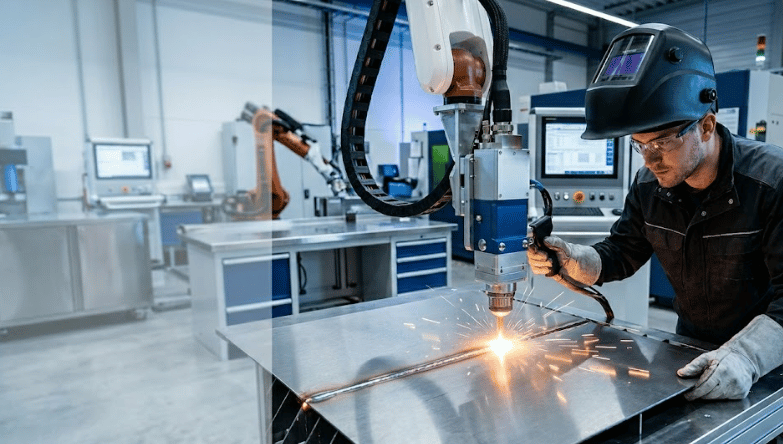
Industrial production has reached a stage where traditional joining methods are no longer enough to meet modern expectations. Companies today operate in highly competitive environments where product accuracy, structural strength, and manufacturing speed must all exist together. This combination of requirements has pushed industries toward more advanced fabrication technologies that can deliver stable and repeatable results.
Among these innovations, laser welding has become a core technology for next-generation manufacturing. It uses concentrated light energy to create precise fusion between materials, offering exceptional control over heat input and minimizing deformation. This makes it highly suitable for applications where even the smallest inconsistency can affect performance or safety.
Behind every high-performance welding system is the expertise of a laser welding machine manufacturer, whose role goes far beyond assembling hardware. These manufacturers design, engineer, and optimize complex systems that combine optics, electronics, thermal regulation, and automation logic into a single functional unit capable of supporting modern industrial demands.
The Transformation of Welding Technology in Modern Industry
Welding technology has evolved significantly from traditional flame-based and arc-based methods to highly controlled laser systems. Earlier techniques often produced uneven heat distribution, requiring additional finishing processes and limiting precision in complex assemblies.
Laser welding changes this approach by focusing energy into a narrow beam, allowing material surfaces to merge with controlled penetration and minimal thermal spread. This results in cleaner welds, stronger joints, and reduced material stress.
As industries continue to demand higher quality output with faster turnaround times, laser welding has become an essential part of advanced manufacturing ecosystems.
See also: Why the Future of Advanced Manufacturing Depends on the Right Linear Motors Supplier
Engineering Complexity Behind Laser Welding Systems
A laser welding system is not a simple machine. It is a highly integrated engineering structure where multiple scientific principles operate together. Optical alignment, beam stability, heat control, and motion synchronization must all function without disruption.
A laser welding machine manufacturer must therefore have deep technical understanding across several disciplines, including photonics, mechanical engineering, thermal dynamics, and automation control systems.
Each system must be carefully engineered to ensure consistent beam performance and stable energy output under continuous industrial operation. Even minor variations in system design can influence weld quality and long-term machine efficiency.
This level of complexity makes manufacturing expertise a critical factor in system reliability.
Why Precision Has Become the Core Industrial Requirement
Modern manufacturing is built on precision. Products are becoming smaller, more detailed, and more dependent on exact structural integrity. In such environments, even minimal welding imperfections can result in performance issues or product failure.
Laser welding technology addresses this challenge by providing controlled energy application that allows precise material bonding without excessive heat distortion. This ensures consistent output across large-scale production cycles.
As industrial standards continue to rise, precision has shifted from being an advantage to becoming a necessity for global competitiveness.
Efficiency Improvements Through Laser Welding Technology
Efficiency plays a crucial role in modern production systems. Traditional welding processes often require multiple post-processing stages such as grinding, polishing, or correction work to achieve acceptable results.
Laser welding significantly reduces these additional steps by producing high-quality welds directly during the process. This leads to faster production cycles and improved workflow efficiency.
In addition, laser systems can operate at high speeds without compromising accuracy, making them ideal for mass production environments where time and quality must remain balanced.
Integration With Smart and Automated Manufacturing Systems
Manufacturing is rapidly moving toward fully automated and digitally connected environments. Machines are expected to communicate, self-adjust, and operate with minimal human intervention.
Laser welding technology fits naturally into this ecosystem due to its compatibility with robotics, CNC systems, and intelligent control platforms.
A modern laser welding machine manufacturer designs equipment that supports digital integration, real-time monitoring, and automated process control. This enables manufacturers to achieve higher productivity while maintaining consistent quality standards.
As Industry 4.0 continues to expand, laser welding systems are becoming essential components of intelligent production networks.
Versatility Across Multiple Industrial Applications
One of the most valuable features of laser welding technology is its adaptability. It can be used across a wide range of materials and industries, including automotive production, aerospace engineering, electronics manufacturing, energy systems, and precision tooling.
Different applications require different levels of energy control, beam focus, and welding depth. This requires systems that can be configured and adjusted according to specific industrial needs.
Manufacturers must therefore develop flexible solutions that can perform reliably across diverse operational environments.
Reliability and Long-Term Operational Stability
Industrial production environments demand equipment that can function continuously under heavy workloads. Any downtime can lead to production delays and financial losses.
Laser welding systems are engineered with stable optical components, advanced cooling mechanisms, and durable mechanical structures to ensure consistent long-term operation.
A high-quality laser welding machine manufacturer focuses on system reliability by minimizing mechanical wear and optimizing performance stability.
This ensures that production lines can operate smoothly without frequent interruptions.
The Future of Laser Welding Technology
The future of laser welding is closely linked to advancements in automation, artificial intelligence, and digital manufacturing systems. Emerging technologies are expected to introduce real-time quality control, adaptive beam adjustment, and predictive maintenance capabilities.
These improvements will enhance welding precision while reducing the need for manual intervention in industrial processes.
Manufacturers who invest in innovation today will play a leading role in shaping the next generation of manufacturing systems.
Conclusion
Laser welding technology has become a cornerstone of modern industrial manufacturing due to its ability to deliver precision, efficiency, and reliability. It has transformed how industries approach material joining and production optimization.
However, the true effectiveness of this technology depends on the engineering expertise behind it.
A laser welding machine manufacturer is not simply a supplier of equipment but a critical contributor to industrial advancement. Their role in designing, optimizing, and supporting advanced welding systems directly influences manufacturing performance.
As industries continue evolving toward smarter, faster, and more automated production environments, the importance of advanced laser welding systems and their manufacturers will continue to grow as a key driver of industrial progress.