Water has become one of the more crowded corners of the pet industry. Rehabilitation centres, recreational pools, mobile hydrotherapy units and dog-friendly lidos all sell time in water, often in overlapping language. For an owner working out what their dog needs, the vocabulary is the obstacle.
Start with what the water is doing
The physics is the same everywhere. Water supports a dog’s weight, so joints are not loaded as they are on pavement. It resists movement in every direction, so muscle works harder than on land at the same speed. Pressure against the limbs is even and constant, part of why a stiff dog often moves more freely once in than it did walking to the steps. And it slows everything down, which for an anxious dog is often the most useful property of all.
What changes between services is not the water. It is the intent, the supervision, and whether anything is being measured.
Treatment: measured, referred, recorded
Clinical hydrotherapy exists to change a clinical outcome. The dog arrives with a diagnosis, usually on veterinary referral. A qualified hydrotherapist assesses before anything gets wet: how the dog stands, how it moves at a walk and a trot, where muscle has wasted, how far a joint will move before the dog objects. Some centres measure thigh circumference at the same point every visit, because muscle returning to a repaired leg is a number rather than an impression.
Sessions then run so they repeat precisely, usually on an underwater treadmill where depth and belt speed are set by the handler, not chosen by the dog. Progress is written up and fed back to the vet. The dog is a patient, and the sessions are episodes of care.
Exercise: unmeasured, unreferred, and perfectly legitimate
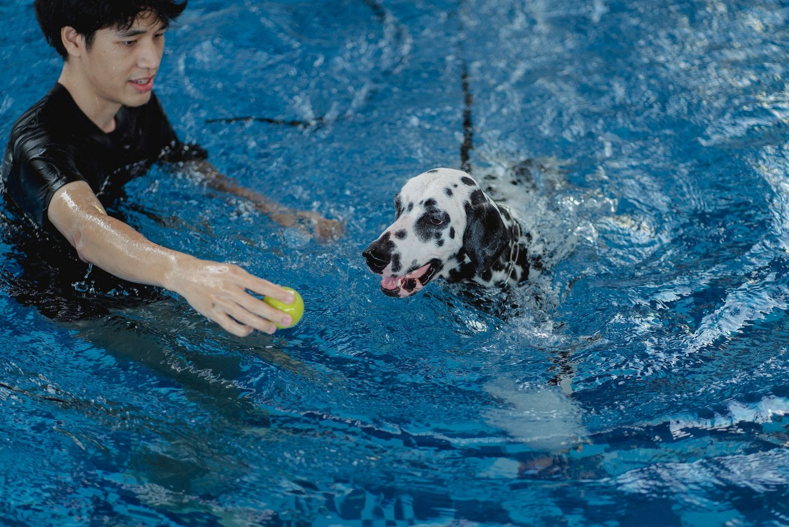
Recreational swimming has no plan, because there is no condition to treat. A healthy dog gets into warm water and swims, plays, rests and swims again. The effort is theirs to set, and most set it sensibly once the first rush of excitement has worn off.
This is genuinely good exercise. It is cardiovascular work with almost no joint loading, it recruits muscle a walking gait barely touches, and it tires a dog in a way that surprises owners the first time: one who walks happily for an hour can be finished after twenty minutes in a pool. It is simply not medicine, and a responsible operator says so before anybody asks.
What a first session actually looks like
A typical recreational booking is around half an hour of pool time, and only a fraction of that is continuous swimming. The dog comes in, looks around, is walked to the steps and left to make its own approach to the edge. A buoyancy aid goes on if needed. The first few entries might last a minute or two each, with rests on the step in between.
For a dog that has never swum, five to ten minutes of actual swimming in a first visit is plenty, built up over later sessions rather than pushed for in one go. Good sessions end while the dog still wants more, which is what makes the second visit easy. Afterwards comes a rinse and a thorough dry, particularly the ears, which hold damp and cause trouble if left wet.
The grey zone, and how to navigate it
Between treatment and recreation sits a large group of dogs: stiffening but undiagnosed, overweight but otherwise well, elderly but not ill, recovered from injury and cleared to exercise. These dogs need no treatment plan, and they do benefit from water.
Take a nine-year-old Labrador, a few kilos heavy, slow to get going in the mornings, no longer up to the two-hour walks he used to enjoy. His owner has three options: assume arthritis and book a clinic, assume nothing and book a swim, or spend twenty minutes at the vet’s first and then actually know. Only the third cannot go wrong. Vets are generally enthusiastic about swimming for dogs who are well enough for it, and clear about the dogs who are not.
What good looks like, whichever you choose
- Warm water. Cold water tightens muscle and raises the risk of strain, which is why serious operators heat year round, typically to the high twenties Celsius.
- A gentle entry. Steps or a ramp, wide enough for a dog to turn round on. No dog should be lifted, carried or dropped in.
- Buoyancy aids available, and used without embarrassment. Confident swimmers do not need one; a badly balanced swimmer needs one most of all.
- Someone trained in canine first aid present throughout, and never out of the room.
- Session length that suits the dog, not the diary. Twenty focused minutes beats a tired hour.
- Somewhere to dry off properly before the drive home.
Private or shared
One structural difference matters more than owners expect. A shared session means other dogs in the water, which for a confident swimmer is fine and for a nervous or reactive dog is the entire problem. Booking a recreational dog pool rather than a clinic often means the choice is yours, and for a first visit the quieter option is almost always better.
Private hire changes what the owner does, too. In an empty pool there is no reason not to get in, and plenty now do. An uncertain dog finds the whole proposition easier when the person it trusts is already standing in it.
See also: The Hidden Cost of Unresolved Leadership Patterns in Family-Owned Businesses
Where owners go wrong
Two mistakes recur. The first is treating water as a substitute for veterinary care, letting a dog swim weekly while a limp that deserved investigating goes uninvestigated. The second is paying clinical rates for what is, in substance, pool hire, because the marketing borrowed clinical language.
Both are avoidable with one question: what is being measured, and by whom? If the honest answer is nothing, that is fine. Plenty of good exercise is unmeasured. It only becomes a problem when somebody charges as though something is.