
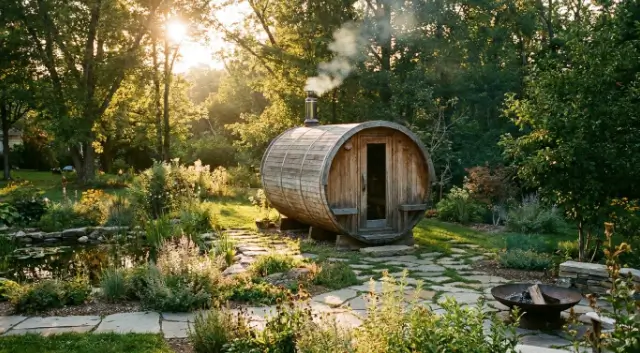
A well-built barrel sauna, maintained properly, typically lasts 15 to 20 years or more, and the maintenance itself is modest: exterior oil or sealant once or twice a year, checking the tension hoops for looseness every few months during the first year, keeping the site graded so water does not pool under the cradle, and clearing snow or debris off the curved roof. Owners who skip site drainage checks are the ones who end up replacing base staves within the first five years.
Maintaining a Barrel Used Several Times a Week
Frequent use puts more cycling stress on the wood and the heater than occasional use, but it does not necessarily mean more maintenance, just more attentive maintenance. An owner using the barrel three or more times a week should check the door seal monthly, since a seal that is compressing unevenly from frequent use will lose efficiency faster than one used occasionally. The heater’s stones also wear out faster under heavy use and typically need replacement every one to two years instead of the three to five years a lighter-use household might see. The upside of frequent use is that the wood interior tends to stay drier overall, since the repeated heat cycles help evaporate residual moisture between sessions rather than letting it sit.
Maintaining a Barrel in a Rainy or Humid Climate
The curved roof design sheds rain well by itself, but a barrel sitting in a consistently wet climate still needs more frequent attention to the exterior finish than one in a dry region. Plan on oiling or sealing the exterior wood twice a year rather than once, and pay close attention to the bottom few inches of staves closest to the cradle, since that area dries out slowest after rain. Check the site grading every spring to make sure nothing has shifted to create a low spot where water collects under the base. A barrel in a humid coastal climate benefits from slightly more ventilation gap under the cradle than the minimum, which helps the bottom staves dry between wet stretches.
Maintaining a Barrel Through Its First Winter
The first winter is when a barrel sauna settles into its final shape, and that means the tension hoops need more frequent checking than in later years, roughly every two to three months as temperature swings cause the wood to contract and expand. Snow load on the curved roof is rarely a structural concern given the shape, but it should still be cleared periodically to prevent meltwater from refreezing against the roof seams. Cold weather can stiffen door gaskets, so check that the door still seals fully once temperatures drop consistently below freezing, and adjust the latch tension if a gap appears.
Maintaining a Barrel Left Unused for Long Stretches
A barrel sauna used only occasionally, say monthly or seasonally, faces a different maintenance profile than one in daily rotation. Wood that sits without heat cycling for weeks at a time holds ambient moisture longer, which makes exterior sealing even more important as the primary defense against rot. Run the heater briefly every few weeks even without a full session, since the heat cycle itself helps dry out any moisture that has crept into the wood during a long idle stretch. Check for pest activity around the base more often too, since an unused structure is more attractive to insects than one that sees regular heat exposure.
What Actually Causes a Barrel Sauna to Fail Early?
Across all of these use cases, one issue shows up more than any other in barrels that fail well before their expected lifespan: standing water under the cradle from poor site drainage. A site that looked flat at installation can develop a low spot after a season or two of settling, and water pooling against the base staves rots wood far faster than sun or heat exposure ever will. Checking site grading once a year, ideally after heavy rain, catches this before it becomes a structural problem rather than a cosmetic one.
A close second is neglecting the tension hoops long enough that a stave shifts out of alignment. Once a gap opens between staves, rain and condensation get behind the wood surface in a spot that was never designed to be exposed, and that kind of damage is much harder to fix than simply retightening a hoop before a gap ever forms. Both issues share the same lesson: barrel saunas fail from small, ignored problems compounding over a season or two, not from any single dramatic event.
Does the Research on Regular Use Support the Maintenance Investment?
A review in Mayo Clinic Proceedings on the cardiovascular and other health associations of sauna bathing found the strongest associations among people using a sauna several times a week rather than occasionally, and a systematic review of regular dry sauna bathing in Evidence-Based Complementary and Alternative Medicine reports comparable patterns tied to sustained, frequent use. Most of this research is built on traditional Finnish-style dry sauna generally, not barrel construction specifically, and it describes population-level association rather than proof for any one household. It is still a reasonable reminder that a barrel sauna maintained well enough to support years of regular use is worth more to a household than one that degrades within a few seasons from a skipped maintenance task, since the reported associations concentrate among people who kept up a sauna habit over years, not months.
Where to Check Model-Specific Maintenance Guidance
Wood species and stave thickness both affect exactly how often exterior treatment is needed, and that information varies by maker even at the same nominal diameter. Checking the specific model page, including on retailers like sweatdecks.com, for the manufacturer’s stated wood treatment and hoop-tightening schedule is worth doing before assuming a generic maintenance timeline applies to every barrel on the market.
Frequently Asked Questions
How often should I oil or seal a barrel sauna’s exterior wood? Most cedar and thermally modified wood barrels need exterior oil or sealant once or twice a year, more often in climates with intense sun or heavy rain. Untreated cedar will still hold up structurally but weathers to gray over time.
How often do the tension hoops need tightening? Check every few months during the first year as the wood settles, then roughly twice a year after that. A hoop loose enough to show daylight between staves needs attention before the next use.
Can a barrel sauna be used year-round in cold climates? Yes, barrel saunas are commonly used through winter, and heat cycling helps keep interior humidity in check. The main winter task is clearing snow off the roof and checking the door seal.
What is the most common cause of early barrel sauna failure? Standing water under the cradle from poor site drainage is the most common cause of premature rot in the base staves. Grading the site to slope away from the barrel prevents most of this damage.
References
- Cardiovascular and Other Health Benefits of Sauna Bathing: A Review of the Evidence, Mayo Clinic Proceedings, 2018
- Clinical Effects of Regular Dry Sauna Bathing: A Systematic Review, Evidence-Based Complementary and Alternative Medicine, 2018
- Does the Combination of Finnish Sauna Bathing and Other Lifestyle Factors Confer Additional Health Benefits? A Review of the Evidence, Mayo Clinic Proceedings, 2023
By Jonas Petrelli
